Heritage: Recently, I’ve been thinking quite a bit about heritage and what that word actually means to me.
It’s an all-encompassing term.
There are the tangible things and the intangible ones. The personal and the cultural. Traditions, values, stories, recipes, land, names, beliefs, habits, and physical objects passed from one generation to the next.
Some things are handed to us intentionally.
Others just arrive.
Building Brolo has me thinking about heritage quite a bit.
The cigar industry, maybe more than most, loves heritage. Many brands benchmark their quality against generational pedigrees, old-world traditions, luxury positioning, or some combination of the three. Families who have worked with tobacco for generations. Names that stretch back a hundred years or more. Stories with roots deep enough to make whatever they're selling today feel connected to something much older.
And there's something beautiful about that.
But where does that leave a kid like me?
I didn't grow up with a mother and father.
There isn't some great family enterprise being handed down to me. I didn't serve in the Armed Forces, and the only time I was involved with law enforcement was usually in the back of a squad car.
What the heck is my heritage?
And if heritage matters so much, how am I supposed to compete with that?
So I started digging.
Not through ancestry records or old family photographs, but through the things that got me here. The memories. The scars. The people. The failures. The things I learned accidentally and the things life taught me, whether I wanted the lesson or not.
I started asking myself:
What makes Brolo, Brolo?
The first image that came to mind wasn't tobacco.
It was a hay bale.
I was probably six or seven years old.
During the summer, my Grandma would drop me off for a week at my birth mother's trailer in East Texas, back behind the Pine Curtain.
Every summer, I dreaded it.
My second stepdad was quite a doozy...a real piece of work. Abusive. Violent. Looking back now, I can see he was probably just an angry boy trapped inside a man's body.
But when you're six, you don't have that kind of perspective.
You just know you're scared.
They lived in the country....or, as East Texans pronounce it, the cunnnn-trrrryyyyyyyy.
The acreage seemed to stretch forever, with a little creek running along the back of the property. My mother worked all day as a nurse, and my stepdad worked as a carpenter, taking odd jobs here and there.
I don't remember him being particularly great at woodworking.
But the man sure knew how to rip a doobie.
Wherever they were, I wasn't.
Most days, I was on my own, traversing the countryside. Climbing hay bales. Jumping hay bales. Falling off hay bales.
And, eventually, crying next to hay bales.
I remember getting hurt out there once.
And I remember being angry with myself for getting hurt.
Scared because I didn't know if I'd be able to survive a sprained ankle, let alone another week unsupervised.
Broken because I was alone and hurting.
And nobody showed up that day to help me.
Although that was the first time I remember feeling it, it certainly wasn't the last.
Those experiences taught me independence.
Eventually, they also taught me control.
If nobody is coming, you learn to handle things yourself. You learn to anticipate problems. You learn not to need much. You learn how to survive.
Useful skills.
Until they're not.
Because somewhere along the way, independence can become isolation. Self-reliance can become control. And learning not to need anyone can leave you desperately wanting someone.
Maybe that's heritage, too.
Not everything passed down comes in a box.
A few weeks ago, I went to the doctor for a regularly scheduled checkup. Somewhere between the blood pressure cuff and the usual questions, she started asking about my family.
Heart disease?
Cancer?
Diabetes?
High blood pressure?
She was trying to understand my family history...to identify the things buried somewhere in my DNA that might eventually become part of my story.
In other words, she wanted to know:
What runs in your family?
It's a clinical question.
But I've thought about it differently ever since. Because a lot more than disease runs in families.
Work ethic runs in families.
Faith runs in families.
Temper runs in families.
Generosity runs in families.
Addiction runs in families.
The way we handle money. The way we argue. The way we love. The way we apologize....or don't. The things we celebrate and the things we refuse to talk about.
Somewhere along the way, all of it becomes inheritance.
We tend to romanticize heritage.
Grandpa's watch. Dad's old truck. Mom's recipe written in her handwriting. The family Bible with names and dates scribbled across pages yellowed by time.
And those things matter.
But heritage has a shadow side, too.
Some things are worth preserving.
Some things are worth restoring.
And some things need to end with us.
My childhood was a lonely one through no fault of my own.
As I got older, I started pursuing people.
At first, probably because I was afraid to be alone.
I was tired of being alone.
I was starving for belonging.
But somewhere in that pursuit, I discovered something much better than simply not being alone.
I found connection.
If this were one of my gospel-centered recovery pieces, this is probably where I'd spend the next thousand words talking about how human beings were created for connection.
And I believe that.
I believe true connection begins vertically...with God...and that healthy relationships with one another are a by-product of that relationship.
But that's another rabbit hole for another day.
Back to connection.
Because that's what Brolo is about.
Not heritage manufactured through some bullshit origin story.
Not luxury for luxury's sake.
Not pretending we've been making cigars since 1873.
Connection.
It's the early-morning text from a friend encouraging you to succeed while simultaneously making light of your many proclivities.
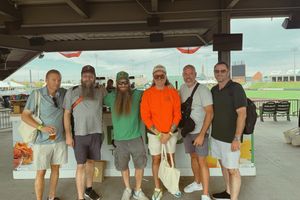
It's the random Tuesday-night HERF where, for whatever reason, the whole crew shows up, and you belly laugh until your face hurts.
It's an early-morning coffee where somebody finally stops saying they're "good" and tells you what's actually going on.
It's spending so much time smoking cigars together that you know your buddy's palate almost as well as your own. You know what he's going to love. You know what he's going to hate. And occasionally, you make a recommendation that he actually likes.
It's getting bombed by one of the Brolo's.
It's seeing the UPS truck turn onto your street....or maybe even chasing it down, and feeling that little dopamine hit because you know there's a box headed your way.
It's knowing that whatever ails you, somebody is rooting for you.
It's complete strangers finding each other in some random corner of Discord or Reddit, sharing a cigar through a screen, and eventually becoming friends in real life.
Those things probably don't sound like heritage.
At least not the way the word is usually sold to us.
There aren't any centuries-old family photographs.
No tobacco fields passed from father to son.
No crest.
No pedigree.
But maybe I've been thinking about heritage all wrong.
Maybe heritage isn't just about where you came from. Maybe it's about what you carry forward.
And maybe the things we weren't given are sometimes the very things we become most determined to give away.
I didn't inherit a great legacy of connection.
So I built my life around finding it.
And now we're building Brolo around giving it away.
Maybe that's my heritage.
Not the kind printed on the inside of a cigar box. Not a family crest, a famous last name, or some romantic story about generations of men who came before me.
It's messier than that.
There's some good in it. There's some bad. There are things I'm proud to carry forward and others I've spent most of my adult life trying to put down.
But all of it got me here.
And I suspect the same is true for you.
What's your heritage?
Not just where your family came from or the traditions you grew up with.
What did you inherit?
What runs in your family?
What did someone teach you without ever sitting you down to teach it?
What wounds shaped you?
What values stuck?
What traditions still matter?
What parts of the people who came before you can you see when you look in the mirror?
And maybe more importantly:
What are you doing with it?
Because at some point, we stop being merely the recipients of heritage.
We become responsible for it.
We decide what gets carried forward.
What gets restored.
What gets rewritten.
And what ends with us.
Heritage isn't just the story of the people who came before you.
It's happening right now.
In the way you raise your kids. The way you love your spouse. The way you treat your friends. The work you put your hands to. The things you make time for. The things you refuse to compromise. The table you build and the people you invite to sit around it.
Whether you realize it or not, you're leaving something behind.
When I think back to that little boy sitting alone in East Texas, hurt and scared and wondering if anybody was going to show up, I can't change his story.
Nobody came that day.
But I can decide what I do with what he gave me.
Maybe that's why showing up matters so much to me now.
Maybe that's why the table matters.
Maybe that's why connection matters.
Maybe that's why Brolo exists in the first place.
So maybe the better question isn't simply:
What's your heritage?
Maybe it's:
What will someone else inherit because you were here?
What impact have you made, or lack thereof?
And maybe that's convicting...if so...that was my intention.
Kaitlyn and I don't make cigars to avoid life. We make cigars to fully embrace it. The good, the bad...the hurt and the wins.
All around a shared smoke.